Manufacturer selection
How to Choose a Cosmetic Contract Manufacturer in Australia
The 10 questions every founder should ask before signing with a cosmetic contract manufacturer — and the answers that separate the good from the rest.
There’s a strange asymmetry in choosing a cosmetic contract manufacturer. Founders spend weeks comparing serum textures and pantone swatches, then commit to a manufacturing partner after a single discovery call. Three months later, they’re frustrated with the process and quietly wondering whether they should have asked better questions upfront. The right manufacturer is probably the single biggest decision in your launch. Here’s a checklist of ten questions that surface what actually matters before you commit.
1. “What’s your MOQ for a product like mine, realistically?”
Not the marketing-page MOQ. The real one. For your specific category, complexity, and packaging. If they quote you the same minimum they advertise on the website, push back gently. “What if I’m using stock packaging and a base formula?” The flexibility — or lack of it — tells you something about how they work. A manufacturer with rigid MOQs is fine if you’re a larger brand. For a first-time founder, you want a partner who’ll meet you where you are.2. “Can you walk me through your process from first call to dispatch?”
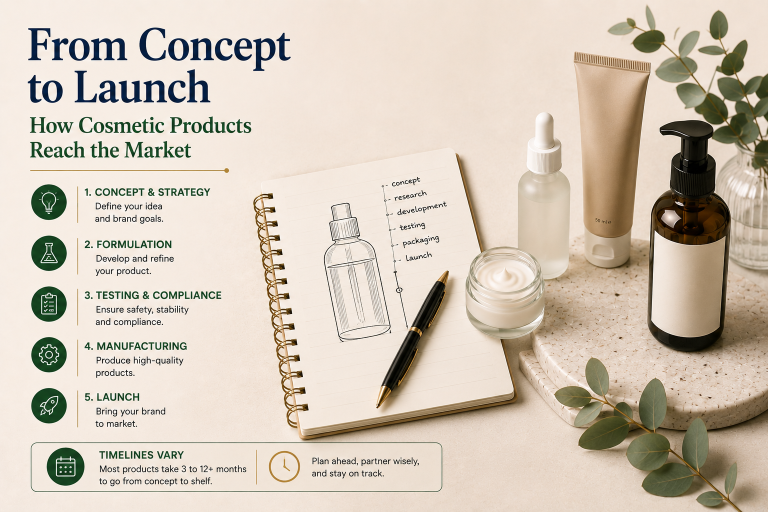
You’re not testing them on process. You’re testing whether they have one. A good manufacturer will describe roughly: discovery, initial formulation direction, lab samples, revisions, packaging coordination, testing, scaling up to production, quality control, dispatch. They’ll give rough timelines for each step. A weaker one will give you generalities or jump straight to talking price. If they can’t describe their own process in detail, it usually means each project gets handled ad-hoc, which is where errors and delays come from.3. “What testing do you do as standard, and what’s optional?”
Stability testing. Packaging compatibility. Preservative efficacy testing (PET). Microbial testing. Some manufacturers include testing in their base price. Others charge separately for each test. Neither is wrong — but you want clarity upfront about what’s covered and what’s a line item later. If they tell you testing isn’t necessary for your product, that’s a flag. Almost every cosmetic product benefits from at least basic stability and compatibility testing. The manufacturer who says “we don’t really do that” usually means they cut corners that come back to bite the brand later.4. “Are you GMP-aligned, and what does that mean in your operation?”
Most reputable Australian manufacturers will say yes. The follow-up matters more. GMP — Good Manufacturing Practice — is a framework, not a single certification. Cosmetic GMP refers to a defined set of practices covering hygiene, ingredient traceability, batch documentation, equipment cleaning, and quality control. Some Australian facilities pursue formal third-party GMP certification; others operate to the same standards without the formal certificate. What you’re really asking is: “Do you have documented procedures for batch records, raw material handling, equipment cleaning, and quality control?” If they can answer that confidently, GMP is real for them. If they get vague, it’s not.5. “What happens if I want to change something between samples?”
You will want to change something. Probably multiple somethings. How many revisions does the manufacturer include before they start charging extra? What’s the cost of an additional sample? How long does each revision cycle take? A manufacturer who gets defensive about revisions is going to be painful to work with. The good ones expect iteration — it’s how you arrive at a product you’re proud of.6. “Who’s my point of contact, and how do they communicate?”
This is the question founders skip and regret. You want to know whether you’ll be talking to a chemist directly, or going through an account manager. Whether they respond on Slack, email, or only by phone. Whether the response time is hours or days. A boutique-focused manufacturer usually gives you direct access to the technical team. Larger operations route everything through account management. Neither is inherently better, but the experience is wildly different.7. “Can I see examples of products you’ve worked on?”
NDAs make this complicated. Most manufacturers can’t name their clients directly, especially for private label work. But they should be able to describe project types. “We’ve manufactured treatment serums and clinic-dispense skincare ranges for Australian beauty retailers.” “We’ve done custom formulations for several brands now stocked in Australian beauty retailers.” If they can’t even describe categories of work, it suggests either inexperience or confidentiality concerns that are too tight to give you confidence.8. “What’s your minimum lead time, and what causes delays?”
Honesty is what you’re testing for here. A manufacturer who claims they can do anything in 8 weeks is either lying or about to disappoint you. Realistic timelines are 12–24 weeks for a custom formulation, depending on complexity and packaging. You want them to name the things that typically cause delays — packaging supplier lead times, raw material availability, stability testing windows. The ones who acknowledge those realities are the ones who actually plan around them.9. “What happens after my first batch?”
A lot of founders only think about the first run. The manufacturer is thinking about the relationship. How do reorders work? Is there a minimum gap between batches? Do raw materials need to be re-sourced each time, or are they held in stock? What happens if you want to reformulate down the track? A manufacturer who can talk fluently about long-term partnership is one who plans to be your partner for years. The ones who can only describe the first project are usually orchestrating one-off transactions.10. “What kind of brand isn’t a good fit for you?”
This is the question that separates the marketers from the operators. A manufacturer who tells you they can do everything for everyone probably can’t do anything particularly well. The ones who have a clear sense of who they serve — boutique brands at this scale, retail-ready brands at that scale, brands focused on these categories — are the ones who’ll do good work for the brands they actually fit. If they tell you they’re not a fit for, say, 100-unit runs, or for products requiring TGA approval, or for cheap-as-possible private label without quality requirements — that’s not a weakness. That’s clarity.What the answers actually tell you
Run through these ten questions and you’ll learn three things about any manufacturer. Whether they have systems. Do they have a documented process, or do they wing it? You want systems. Whether they’re honest. Do they acknowledge constraints, timelines, and limitations? Or do they tell you what you want to hear? Honesty now saves arguments later. Whether they fit your stage. A manufacturer brilliant at 50,000-unit retail runs isn’t necessarily good for a 500-unit boutique launch. Same in reverse. The right fit matters more than the most impressive client list.The boring summary
Choose a cosmetic contract manufacturer the way you’d choose a co-founder, not the way you’d choose a printer. Process, communication, and fit matter more than price quotes. Price differences across reputable Australian manufacturers are usually within 15–20% of each other — the experience of working with them varies by orders of magnitude.Related reading
- Stability testing for cosmetics: what it costs and why you can’t skip it
- MOQs for cosmetic manufacturing in Australia: what’s realistic in 2026
- From concept to first batch: realistic timelines for a skincare launch
Related: see our Melbourne cosmetic contract manufacturer overview.
Let's create something exceptional together.
Email us with your category, target volume, and timeline. We respond to every enquiry within one business day.